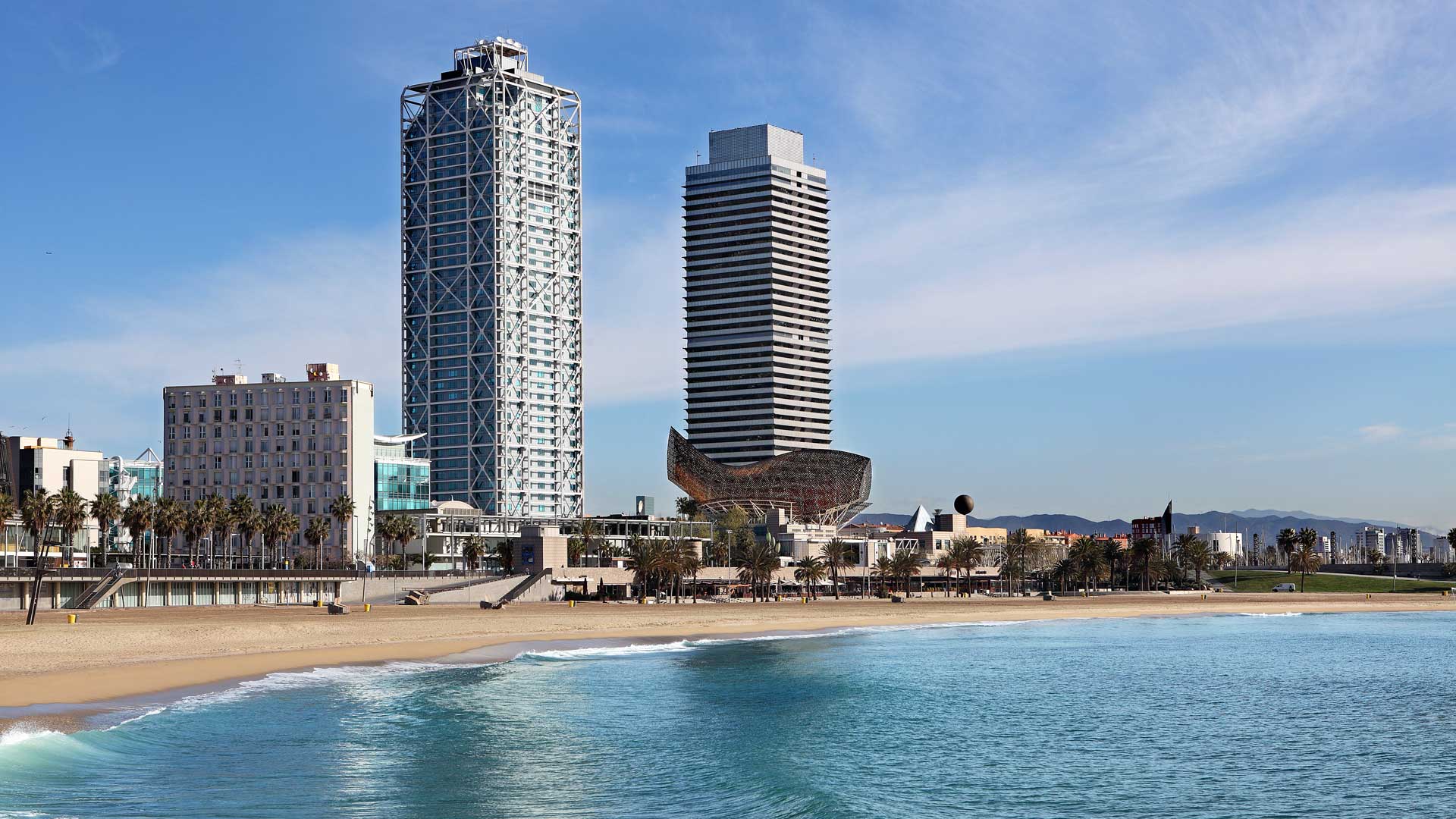
The Olympic Village of Poblenou is a neighborhood in the Sant Martí district of Barcelona, Catalonia (Spain). It was constructed in the late 1980s and early 1990s for the 1992 Summer Olympic Games which took place in Barcelona. Its construction was devised by Oriol Bohigas, David Mackay and Albert Puigdomènec as a residential area in the otherwise industrial and working-class district of Poblenou, which underwent regeneration but involved massive expropriation, as well as the destruction of a sizeable portion of the district, including Industrial Revolution factories of architectural value such as Fàbrica Foret. It follows essentially the reticular outline of Eixample and Poblenou, with about 2000 new apartments in the area, owned by the mixed public-private company VOSA (Vila Olímpica Societat Anònima).
 On the left, the Olimpic Port, downtown,the Mapfre Tower and right, the buildings of the Olimpic Village Pobleno.
 It
is a neighborhood popular with foreign visitors because of its
proximity to Barcelona's beaches and nightlife of the Olimpic Port, as
well as some theaters that screened that original versions with
subtitles shopping district.
It
is a neighborhood popular with foreign visitors because of its
proximity to Barcelona's beaches and nightlife of the Olimpic Port, as
well as some theaters that screened that original versions with
subtitles shopping district. The
Arc de Triomf (Catalan pronunciation: [ˈarɡ də tɾiˈomf]) is an arch in
the manner of a memorial or triumphal arch in Barcelona (Catalonia,
Spain). It was built as the main access gate for the 1888 Barcelona
World Fair by architect Josep Vilaseca i Casanovas.
The
Arc de Triomf (Catalan pronunciation: [ˈarɡ də tɾiˈomf]) is an arch in
the manner of a memorial or triumphal arch in Barcelona (Catalonia,
Spain). It was built as the main access gate for the 1888 Barcelona
World Fair by architect Josep Vilaseca i Casanovas.The arch is built in reddish brickwork in the Neo-Mudéjar style. The front frieze contains the stone sculpture Barcelona rep les nacions (Catalan for "Barcelona welcomes the nations") by Josep Reynés. The opposite frieze contains a stone carving entitled Recompensa (Recompense), a work from Josep Llimona's the earliest period, representing the granting of awards to the participants in the World Exposition. The friezes along the sides of the arch include allegories of Agriculture and Industry, works by Antoni Vilanova, and of Trade and Art by Torquat Tassó.
The arch presides over Passeig de Lluís Companys, a wide promenade leading to the Ciutadella Park. It is located at the top of the promenade, where it meets Passeig de Sant Joan.
Similar structures, though with other uses or aims, can be found in Paris (France), London (England), Brooklyn (New York, USA) and Bucharest (Romania), among many others.This is the main frieze of the Arch in the city of Barcelona welcomes the nations participating in the exhibition. The central figure is a personification of Barcelona, which is denoted by the shield of Barcelona that is engraved on the chest. It is flanked by Cibeles, goddess of Mother Earth, crowned with a tower; and Athena, goddess of war, civilization, wisdom, arts and justice, wearing a coat with the letters P and F, referring to the progress and happiness.
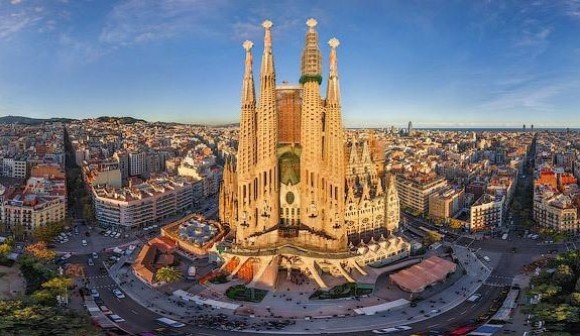
The Basílica i Temple Expiatori de la Sagrada Família (Catalan pronunciation: [səˈɣɾaðə fəˈmiɫiə]; English: Basilica and Expiatory Church of the Holy Family) is a large Roman Catholic church in Barcelona, designed by Spanish architect Antoni Gaudí (1852–1926). Although incomplete, the church is a UNESCO World Heritage Site, and in November 2010 Pope Benedict XVI consecrated and proclaimed it a minor basilica, as distinct from a cathedral, which must be the seat of a bishop.
Construction of Sagrada Família had commenced in 1882 and Gaudí became involved in 1883, taking over the project and transforming it with his architectural and engineering style, combining Gothic and curvilinear Art Nouveau forms. Gaudí devoted his last years to the project, and at the time of his death at age 73 in 1926, less than a quarter of the project was complete.
Sagrada Família's construction progressed slowly, as it relied on private donations and was interrupted by the Spanish Civil War, only to resume intermittent progress in the 1950s. Construction passed the midpoint in 2010 with some of the project's greatest challenges remaining and an anticipated completion date of 2026, the centenary of Gaudí's death.
The basílica has a long history of dividing the citizens of Barcelona: over the initial possibility it might compete with Barcelona's cathedral, over Gaudí's design itself, over the possibility that work after Gaudí's death disregarded his design, and the recent proposal to build an underground tunnel of Spain's high-speed rail link to France which could disturb its stability. Describing Sagrada Família, art critic Rainer Zerbst said, "It is probably impossible to find a church building anything like it in the entire history of art" and Paul Goldberger called it, "The most extraordinary personal interpretation of Gothic architecture since the Middle Ages."

The church shares its site with the Sagrada Família Schools building, a school originally designed by Gaudí in 1909 for the children of the construction workers. Relocated in 2002 from the eastern corner of the site to the southern corner, the building now houses an exhibition.
 La Rambla (Catalan pronunciation: [ɫə ˈrambɫə]) is a street in central Barcelona, popular with tourists and locals alike. A tree-lined pedestrian mall, it stretches for 1.2 kilometres (0.75 mi) connecting Plaça de Catalunya in the centre with the Christopher Columbus Monument at Port Vell. La Rambla forms the boundary between the quarters of Barri Gòtic, to the east, and El Raval, to the west.
La Rambla can be crowded, especially during the height of the tourist season. Its popularity with tourists has affected the character of the street, with a move to pavement cafes and souvenir kiosks. It has also suffered from the attention of pickpockets and, especially towards its southern end, sex workers.

 The Spanish poet Federico García Lorca once said that La Rambla was "the only street in the world which I wish would never end."
La Rambla can be considered a series of shorter streets, each differently named, hence the plural form Les Rambles (the original Catalan form; in Spanish it is Las Ramblas). The street is successively called:
The Spanish poet Federico García Lorca once said that La Rambla was "the only street in the world which I wish would never end."
La Rambla can be considered a series of shorter streets, each differently named, hence the plural form Les Rambles (the original Catalan form; in Spanish it is Las Ramblas). The street is successively called:Rambla de Canaletes - the site of the Font de Canaletes fountain
Rambla dels Estudis - the site of the former Jesuit University, whose only remainder is the Church of Bethlehem
Rambla de Sant Josep (or de les Flors) - the site of an open-air flower market
Rambla dels Caputxins - the site of a former Capuchin monastery, now dominated by the Liceu opera-house
Rambla de Santa Mònica - named after the convent of St. Monica, now an arts centre.
To the north of La Rambla lies Plaça de Catalunya, a large square in central Barcelona that is generally considered to be both its city centre and the place where the old city and the 19th century-built Eixample meet.
To the east of La Rambla is the Barri Gòtic or Gothic Quarter, the centre of the old city of Barcelona. The Barri Gòtic retains a labyrinthine street plan, with small squares and streets, many of which connect onto the Rambla. One of the larger of these squares is the Plaça Reial, a lively 19th century square with tall palm trees and street lamps designed by Antoni Gaudí, which opens down a short entrance passage off the Rambla dels Caputxins. Further into the Barri Gòtic can be found the Cathedral of Santa Eulàlia and the Plaça Sant Jaume that houses the buildings of the Generalitat of Catalonia and Barcelona’s City Council.
 To the west of La Rambla is the rather different El Raval quarter. Outside the city's earliest walls, this area was originally the site of various religious and medical institutions. Later factories grew up along with housing for the workers, whilst the proximity to the port led to the area becoming known for its nightlife and cabarets, as well as prostitution and crime. Today the area still retains a degree of 'edge', but it also home to several important buildings, including Gaudí's Palau Güell, which is only a few steps down the Carrer Nou de la Rambla from the Rambla dels Caputxins.
 At the southern end of the Ramblas is the Christopher Columbus Monument and the Port Vell, the old port of Barcelona, now largely given over to pleasure craft. Near to the port end of the Rambla are the Royal Dockyards (in Catalan, Drassanes), which house a maritime museum specifically devoted to naval history in the Mediterranean.
Extensions at either end of the Rambla also carry the name Rambla, but are not normally considered part of La Rambla itself. To the north, the Rambla de Catalunya extends into the Eixample district. To the south, construction of the Maremàgnum in the early 1990s resulted in a continuation of La Rambla on a wooden walkway into the harbour called the Rambla de Mar.

没有评论:
发表评论